The Essential App for Time Travelers: Modern Civilization in One Phone
We put MiniCPM5-2B inside zllm-app and ran it fully offline on a Qualcomm NPU. With one phone, a time traveler can grow food, make fertilizer, brew, translate, train teams, and bootstrap civilization.
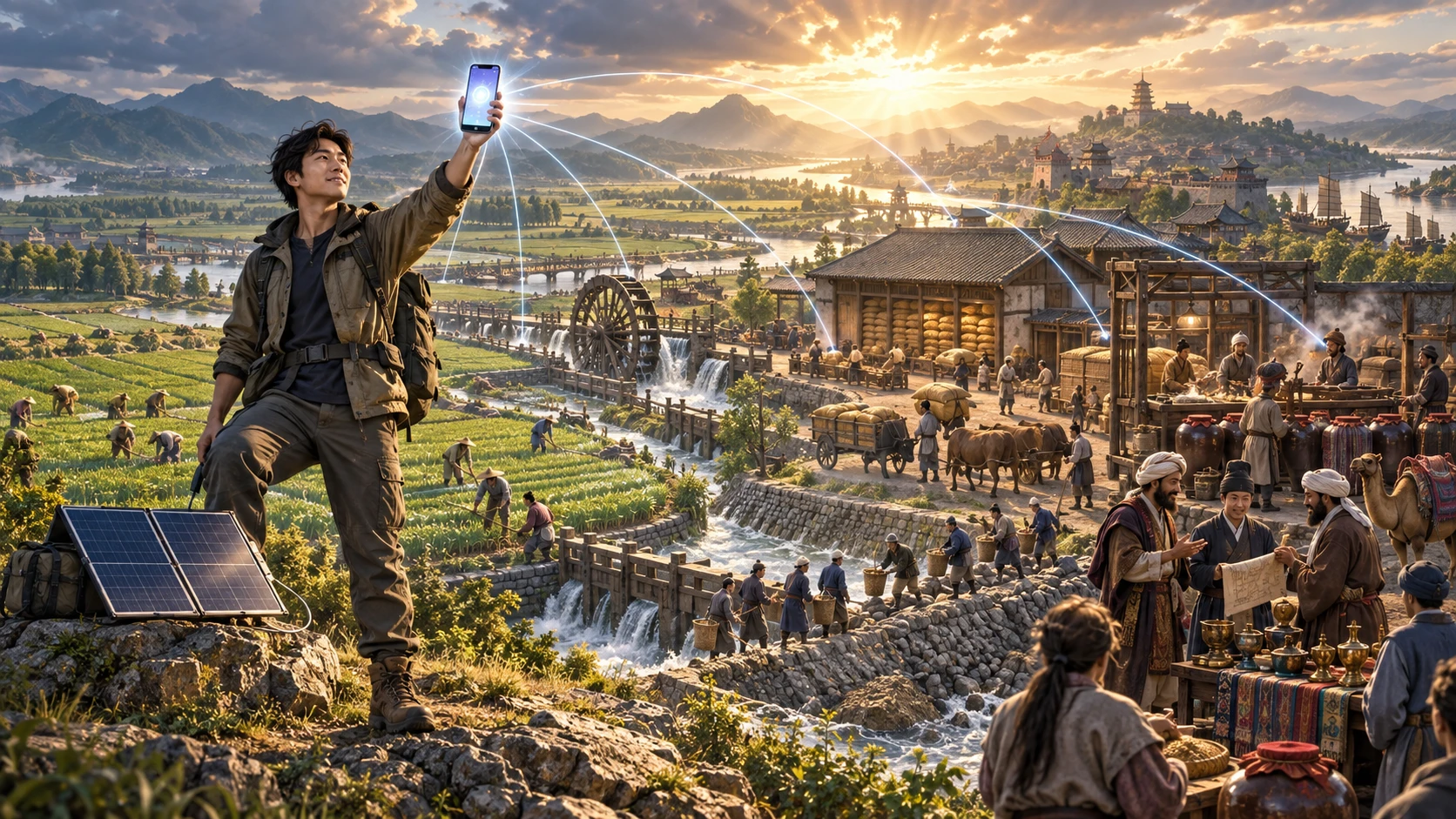
Suppose you wake up tomorrow in the ancient world.
There is no power grid, no internet, no search engine, and certainly no cloud LLM. You cannot recite an encyclopedia of preindustrial technology from memory. You vaguely remember crop rotation from a video, but when a harvest depends on it, all that remains is one terrifying question: how exactly was that done?
Other time travelers bring a lighter. You bring a phone running zllm-app.
Inside it is the complete MiniCPM5-2B model. The weights are the knowledge. No network, no server, and no prewritten question list are required. Growing grain, making fertilizer, brewing alcohol, translating languages, building waterwheels, organizing workshops, training a disciplined force—if you can ask it, you can start working on it.
Add a foldable solar panel and a power bank: harvest sunlight by day, summon modern civilization by night.
This is not time travel. This is administrator access.
First we type a time-traveler opening question. MiniCPM5-2B immediately lays out a path through farming, fertilizer, brewing, and disciplined organization. Then we type one Chinese sentence and get English, Japanese, and Korean on the spot. Airplane mode cannot stop it, because every answer is generated inside the phone.
Put the artifact in your pocket
Download zllm-app 0.1 SM8635 Preview APK (8.7 MB)
SHA-256: d3cbc48b928da4932cea37c4538dc0ed687336b1c4d5d93d18692b3f92d2cb5a
This is a directly installable technical preview. The APK does not cram a 2B model into the installer. On first launch, it races Hugging Face against ModelScope and downloads the faster copy of the roughly 2.6 GiB core model, with resumable transfers and SHA-256 verification. Once the model is in place, conversations work without a network.
Current device restrictions
| Item | Current support boundary |
|---|---|
| Fully validated phone | Motorola XT2451-4 |
| SoC / NPU | Qualcomm SM8635 (Snapdragon 8s Gen 3) / HTP V73 |
| Memory | 12 GB validated; lower-memory devices are not currently supported |
| OS and ABI | Android 16 and arm64-v8a validated |
| Storage | Core model is about 2.6 GiB; reserve at least 4 GiB |
The current model package and QNN context graphs are built specifically for SM8635 / HTP V73. Other Snapdragon chips and HTP versions, as well as MediaTek, Samsung, and Kirin platforms, are outside the current support boundary. The artifact has arrived—but this release answers to one NPU only.
Civilization is not in the cloud. It is in the weights.
Most AI apps become an empty input box when the network disappears. zllm-app is different: the MiniCPM5-2B weights, tokenizer, chat template, and inference engine all live on the phone.
You ask; the phone computes. The model answers; the text is generated locally. Nothing needs to be sent to a server, and no reply has to travel back from an internet connection a thousand years in the future.
Text ───────────────────────┐
                            ↓
Voice → local SenseVoice → MiniCPM5-2B
                            ↓
                    Qualcomm HTP/NPU
                            ↓
              Streaming output and saved chats
As long as the phone can light up, the knowledge is still there.
We actually ran it on a Qualcomm NPU
“An LLM on a phone” is easy to put on a slide. Making it real is a different kind of battle.
Our test device is a Motorola XT2451-4 with an SM8635, 12 GB of RAM, and HTP V73, running QAIRT 2.38. We did not dump the model onto the CPU and wait. We integrated Qualcomm QNN directly: dynamically loading libQnnHtp.so, creating the backend, device, context, and execution graphs, then sending MiniCPM5-2B's core computation to the phone's NPU.
The embedding, all 42 Transformer layers, final normalization, and vocabulary projection now run on HTP. The SenseVoice-Small encoder and CTC head run there as well: hold the microphone, speech becomes text locally, MiniCPM5-2B receives the question, and the answer streams onto the screen.
The integration produced enough traps to fill a book:
- Activation outliers in the fixed prefix distorted the quantization range, driving K/V errors across all 42 layers to unacceptable levels.
- On this hardware and SDK combination, QNN could not use the S32/F16/F32 output paths we originally expected, so we redesigned the path around S8 input, S8 output, and scale restoration.
- Full INT4 was fast but drifted during long generations; full INT8 preserved quality but reached only 8.97 tok/s.
- DSpark speculative decoding ran end to end, but weak draft acceptance reduced it to 5.723 tok/s—slower than ordinary decoding.
- Reloading 43 graphs for every request cost several seconds, so decode and ASR received resident runners that load the graphs once and reuse them.
The final 2B INT8 configuration sustains roughly 8.7–9.8 tok/s on long answers. Reusing resident graphs reduced the second in-app question from 14.1 seconds to 9.65 seconds. For long inputs, batched AR8 prefill takes over: a fresh 831-token conversation fell from 95–143 seconds to 36.9 seconds.
This is not “NPU support” in a presentation. It is a real phone, real QNN graphs, and a complete path from the text box to streaming output.
Question one: how do you survive the first week?
While everyone else is composing poetry, tracing family trees, and looking for a patron, you open zllm-app and solve the problems that actually matter: water, food, shelter, safety, local climate, and the local power structure.
Seconds later, the phone gives you a plan for day one, the first three days, and the first week.
They are still trying to identify the dynasty. You are already building a base.
Question two: how do you double the harvest?
In the ancient world, the real hard currency is not gold. It is grain.
You do not need to memorize an entire agronomy library. Tell zllm-app the climate, the crop, the sowing date, the color of the leaves, and last year's yield. It breaks the problem apart: seed selection, seedlings, rotation, compost, drainage, spacing, weeds, pests, harvest, drying, and storage.
In year one, farmers keep control plots and record seed, fertilizer, and yield for every field. In year two, “the elders say so” becomes a set of comparable records. Which seed produces more? Which compost works? Which field floods? Now you have evidence.
Everyone else depends on the weather. You begin agricultural experiments.
Once the harvest grows reliably, you are no longer feeding only yourself. You can support craftsmen, caravans, guards, and an expanding city.
Question three: how do you make fertilizer without a chemical plant?
A time traveler cannot build a chemical factory on day one. With a model, however, you know where the technology tree begins.
Start with mature compost, green manure, crop rotation, nitrogen-fixing legumes, wood ash, and drainage. Then distinguish nitrogen, phosphorus, and potassium deficiencies from plant symptoms. Change one variable at a time, keep small control plots, and record inputs against yield.
The frightening advantage is not memorizing one recipe. It is knowing how to experiment, debug, and turn a lucky accident into a repeatable method.
One village learns it; ten villages copy it. Ten villages prove it; the yield of an entire region begins to rise.
That is what knowledge can do.
Question four: what comes after surplus grain?
Once agriculture creates a surplus, fermentation is the next branch of the technology tree.
Temperature, sanitation, containers, timing, batch records—zllm-app turns mystical “ancestral intuition” into a process. Record the ingredients, the day each jar was filled, when bubbling began, and when an off smell appeared.
Reliable alcohol becomes trade goods. Vinegar seasons and preserves food. The same fermentation discipline extends to sauces, pickles, and long-term storage.
Other households brew by luck. Your workshop begins quality control.
Question five: no common language? Your phone is the foreign office.
You may not land in the imperial heartland. You might appear on a trade route, at a frontier town, in a port, or among people whose language you cannot understand at all.
Translation is not a luxury there. It is survival.
MiniCPM5-2B's on-device quality regression includes translation samples. The SenseVoice-Small front end supports Chinese, English, Japanese, Korean, and Cantonese; Chinese, English, and Cantonese all passed the phone's HTP transcription gates. A visitor can speak to the phone, while zllm-app extracts the meaning, translates it, and rewrites your reply to sound more polite, formal, or suitable for trade.
Others meet a foreign caravan and resort to gestures. You negotiate prices, ask for routes, read contracts, and compose replies.
One phone becomes translator, scribe, and diplomatic adviser.
Trade routes stop being lines on a map. They become your intelligence network, commercial network, and talent pipeline.
Question six: how do you build a formidable ancient force?
Weapons alone have never determined the strength of an army.
zllm-app gives you an organizational system: teams of ten with clear responsibility; standard commands, formations, and assembly times; regular conditioning, load carrying, marching, watch duty, first aid, and evacuation drills; inventories for provisions and equipment; records for illness and injury; consistent rewards and discipline; a mandatory review after every operation.
Other commanders train according to their mood. You use a standard schedule.
Other columns scatter on the march, lose track of supplies, and garble commands. Your people know who is responsible for whom, where the supplies are, and where to report a problem. In peace they repair levees, fight fires, guard grain, and move cargo. In crisis they act together instead of dissolving into chaos at the first alarm.
What you brought is not a legendary weapon. It is modern organizational science.
That is more powerful than a legendary weapon.
One phone is an entire technology tree
The classic time-traveler mistake is trying to build a steam engine immediately.
The real sequence is different: secure water and food, then establish records and measurement. Once the food supply is stable, organize craftsmen. With craftsmen, improve tools, kilns, waterwheels, and workshops. Only after surplus capacity exists do you advance metallurgy, machinery, transport, and education.
| What you have | What comes next |
|---|---|
| A field and some seed | Rotation, seedlings, compost, control plots, grain storage |
| Surplus grain | Brewing, vinegar, food processing, warehouses |
| Contact with other languages | Translation, trade, diplomacy, technical intelligence |
| Carpenters and blacksmiths | Better tools, waterwheels, standardized dimensions |
| Reliable tax grain | Support craftsmen, open schools, build roads, train teams |
| Mature workshops | Metallurgy, machinery, printing, scaled production |
The model does not conjure machines from thin air. It ensures that you always know the objective, the principle, the missing prerequisites, and the first step.
The time traveler's real cheat code
One phone. MiniCPM5-2B. zllm-app. A Qualcomm NPU. One foldable solar panel.
No network, yet questions still receive answers. No cloud, yet text still appears. Speak once and SenseVoice recognizes it locally. Leave mid-conversation and the chat and KV state remain saved. Start another topic and it receives a completely independent conversation.
Other time travelers rely on whatever fragments they can recall.
You carry an agronomist, process engineer, translator, historian, drillmaster, and chief technology officer who never sleeps.
From the first cup of clean water to the first high-yield field; from the first reliable jar of alcohol to the first disciplined organization; from the first cross-language trade to a technological system that keeps compounding—it all begins with one sentence typed onto a phone.
This is zllm-app.
Completely offline. Modern civilization in your pocket.
If we must find one missing piece, this time-travel artifact still lacks TTS. Once it can speak an answer aloud, the modern strategist inside the phone will not merely write your plans. It will have a voice.
Perhaps that is for the best.
An artifact this powerful should not be revealed lightly.
We will save that voice for the next release.